AMERICAN NUMISMATIC ASSOCIATION
Home Join / Renew Contact Us Site Map
Coin Graphic
Advanced Search
Member Login Donate Teacher Tools ANA Clubs
MembershipExplore the World of MoneyNumismatic EventsCommunicationsShop at MoneyMarket
blue_white spacer image
Explore the World of Money
Education
Are You a New Collector?
FAQs
Tips for Buying/Selling Gold
Money Museum
Virtual Museum
Library
Money'Musements
Young Numismatists
Scout Page
Internships
Job Board
Print this page
side_pic
Text size
[+] [-]
Spacer

Frequently Asked Questions

Below you will find answers to many commonly asked numismatic questions that we receive on a regular basis. If you have a question that does not appear below or for more information about the American Numismatic Association, please contact us at ana@money.org or call 1-800-367-9723. Our museum and library staff will be happy to assist you as you discover and explore the world of money.

Depending upon the extent of the research necessary to answer individual questions, a research fee may be required. If a fee is required, our staff will provide you with a cost estimate before conducting research on your behalf.

Information & Articles on the 50-State Quarter Program

U.S. Coins

1. How may quarter designs will be produced by 2008 under the U.S. Quarters Program?

This is a great time to begin coin collecting while also learning about U.S. history and geography. Beginning in January 1999, the U.S. Mint began the 50 State Quarter™ Program. Over a 10-year period, the Mint will strike a quarter in honor of each of the fifty states produced in the order in which the States ratified the Constitution or joined the Union. Five coins will be released each year.

To obtain more detailed information on each of the State quarters, schedule of releases, design information or to purchase Proof or Uncirculated Mint Sets visit the U.S. Mint website.

2. What women have been portrayed on U.S. coinage?

Aside from idealized versions of "Liberty," Susan B. Anthony, Sacagawea and Helen Keller (Alabama Quarter) are the only "real" women to be immortalized on U.S. circulating coinage. However, Eunice Kennedy Shriver and Queen Isabella of Spain, as well as depictions of women veterans of war and service have been honored on U.S. commemorative coins.

3. When was the motto "In God We Trust" placed on U.S. coinage?

The motto "In God We Trust" was first placed on U.S. coinage in 1864. During the Civil War, an era of high religious sentiment, many U.S. citizens desired that the nation's currency suitably recognize the Deity, as other countries around the world had already done. At the urging of then Treasury Secretary Salmon P. Chase, U.S. one-and two-cent coins were struck bearing the motto in 1864. The "Coinage Act of 1873" declared that "In God We Trust" could be placed on other U.S. coinage.

4. What is a "proof" coin?

Proof and uncirculated coins are not the same and the terms are not interchangeable. During production, the two types of coins employ different striking methods. Proof coins are produced when specially prepared planchets are struck at least twice by specially polished dies. The end product is a coin with a highly mirrored field and very frosted detail. Proof coins are struck for, and generally sold to collectors. Proof coins can be found in circulation if someone has unknowingly, or sometimes purposefully, removed these coins from their holders and used the coins as legal tender.

5. What is an uncirculated coin?

Uncirculated coins are simply business or circulating strikes that have never been touched by human hands. After striking, the coins are specially handled and placed into holders to be sold. The finishes may be similar to proof coins, and sometimes are referred to as "proof-like." However, this type of end product typically is a result of the newness of the dies, not the method of striking.

6. What is a commemorative coin?

Commemorative coins are those U.S. Mint issues that are produced to record and honor a person, place or event. Commemorative coins have been issued as circulating currency or sold specifically as collector items. The 50 State Quarters™ Program currently underway is a good example of circulating commemorative coins.

7. What is a bullion issue?

Bullion issues, or rounds, are items on the fringe of numismatics. Technically, they are not coins since they are not produced for circulation and do not bear a legal-tender value. While bullion rounds are desirable to some collectors, the innate value is more often based on the spot price of the metal content on the world market, rather than the collector or numismatic value. There are many "unofficial" mints and private companies that produce various sizes and types of bullion issues and offer them for sale to the general public. The U.S. Mint currently produces bullion issues in three metals: silver, gold and platinum.

8. What is a Fugio cent?

Fugio cents were the first coins issued under the authorization of the United States in 1787. Abel Buell, of New Haven, Connecticut has been credited with producing the dies. On one side, the coin design features thirteen circles, linked together as a chain with the words, "United States" written in a smaller inside circle. In the very center the legend reads, "We are one." The other side features a sundial in the center, with the word "Fugio" (meaning "time flies") on the left. The wording "Mind Your Business" is at the bottom, with the date 1787 running vertically along the right side. They are about the size of a quarter.

Benjamin Franklin has been credited with creating the legend on the coin. While the design details vary on authentic coins, early strikes were produced in copper. Restrikes have been identified in gold, silver, copper and brass.

9. What is a Continental Currency Dollar?

The Continental Currency piece is similar in style to the Fugio cent, but is about the size of a silver dollar. The monetary denomination of the Continental Currency piece remains uncertain today, so we hesitate to label it a coin. However, most numismatists believe the item held some type of legal-tender value during the Colonial era.

The obverse features a sun and sundial, with the wording "Mind Your Business." The word "Fugio" is written to the left with "Continental Currency" and the date 1776 around the perimeter. Benjamin Franklin has been credited with creating the reverse legend. The words "We Are One" are centered inside a circle reading "American Congress" and thirteen circles linked as a chain surround the perimeter. On each circle is name of one of the original thirteen colonies that united to become the first thirteen states in 1776.

Continental Currency pieces were originally struck in pewter, brass and silver. The spelling on genuine specimens varies between "curency" and "currency." Numerous cast and struck copies have been made and sold as souvenir pieces. Authentication is recommended.

10. Do you have any information on the 1804 Dollar?

The U.S. 1804 dollar is one of the most sought-after numismatic items and has been labeled "The King of Coins." Numismatists are aware of fifteen total specimens, eight of the first reverse and seven of the second reverse. At this point, all are accounted for in known collections. However, one of the enticing factors of numismatics is that there are no absolutes. Since there are no U.S. Mint records relating to the 1804 dollar, the full mintage remains unknown. While it is unlikely, a previously unknown specimen could surface. Beware of replicas and counterfeit copies.

11. Why is the 1913 Liberty Head nickel so valuable?

Recent news reports have brought a great deal of attention to the U.S. 1913 Liberty Head nickel. The story behind the production of these five coins, and the disappearance of one, is shrouded with crime, mystery and intrigue---making it one of the most notorious numismatic rarities.

The U.S. Mint produced the "Liberty Head Type" nickel, designed by Charles E. Barber, from 1883 to 1912. In 1913 the nickel design was changed to James E. Fraser's Indian Head obverse with a Buffalo reverse. However, sometime near the end of the production run in 1912, five coins bearing the Liberty Head design, but with a date of 1913, were surreptitiously produced. Numismatists became aware of the coins in 1919, after Samuel W. Brown placed an ad in the ANA's journal, THE NUMISMATIST, seeking to purchase the "non-existent" coins. Mr. Brown attended the 1920 ANA convention in possession of at least one 1913 Liberty Head nickel. By 1924, five genuine specimens had surfaced.

Over the next four decades, the nickels were purchased and sold several times over, individually or as a set. The most recent specimen sold brought a record price of more than $3,000,000 in a 2003 private transation.

Other Liberty Head nickels dated between 1883 and 1912 were standard circulation issues and may hold a small numismatic value based on the condition of the coin. Please see a local ANA member coin dealer for an evaluation.

Counterfeits and altered coins bearing a 1913 date are abundant. Professional authentication is recommended for any Liberty Head nickel dated 1913.

12. Can you provide information on the 1943 cent?

Most U.S. cents with a 1943 date are silver in color. More than a million were produced, but because they look different that the ones from other years that are made from copper and brown in color, many were saved. A 1943 silver-colored cent (made from a composition of steel coated with zinc) is not rare. A Guide Book of United States Coins (the "Red Book") lists a retail value range for a 1943 steel cent between 20 cents and $1.50, depending on mintmark and condition.

The story behind why the United States changed the medal in the 1943 cent from copper to steel coated zinc is very interesting: During WWII, war needs mandated that copper be allocated to producing shell casings. After much experimentation, the U.S. Treasury deemed that one-cent coins for that year (and only that year) were to be struck from a composition of steel, coated with zinc.

Numerous newscasts and articles have prominently featured stories about a very valuable copper variety of the 1943 cent. Here’s how it happened: Unbeknown to the Mint, in 1943, a few copper planchets or blanks, were still inside the minting machinery, left over from 1942, and were struck with a 1943 date and placed into circulation along with the more than a million steel cents. Eventually a few of the copper 1943 cents found their way into the hands of collectors, with the first reported discovery in 1947. In 1958 the first 1943 copper cent was sold at auction for $40,000.

To date, approximately 15 to 20 1943 cents struck on the copper blanks have been examined and found to be genuine, with specimens representing each Mint. Since the coins were struck accidentally, the exact number remains unknown. Speculation by numismatists varies widely.

Counterfeit copies are numerous. If your 1943 cent appears to be copper, but it sticks to a magnet, it is the very common steel cent that has been coated with copper. These coins hold no numismatic value, and technically no legal value since the coin has been altered. 1948 and 1945 cents with altered dates are also are frequently found.

If your 1943 copper cent does NOT stick to a magnet, you may want to consider taking the coin to an ANA member coin dealer.
Click Here to find a local dealer

13. Why is the letter "P" on the reverse of the 1943 nickel?

War needs during WWII mandated several changes in U.S. coinage from 1941 to 1945. Aside from the well-known 1943 steel cent, the U.S. nickel also did its part in the war effort. From 1942 through 1945, the composition of the coin was changed to what is known as the "wartime alloy" of 56 percent copper, 35 percent silver, and 9 percent manganese to allow the government to use nickel as a strategic material. The mintmark on the previous five cent issue was located on the reverse to the right of the building. In 1942, the large mintmark was placed over the dome of Monticello to denote the change in composition. The letter P (Philadelphia) was also used for the first time as a mintmark. The prewar mintmark, location and composition were resumed in 1946.

14. I found a quarter, half dollar and dollar coin that have two dates 1776-1976. Are these coins rare?

The coins you describe are "Bicentennial" issues produced to commemorate the 200th anniversary of the signing of the Declaration of Independence. Other than the dual dating 1776-1976, the obverses of all three coins remained unchanged from earlier issues. The reverse of the Bicentennial quarter featured a Colonial drummer boy facing left and a victory torch encircled by thirteen stars. The Kennedy half-dollar featured a reverse design of Independence Hall, and the Eisenhower dollar reverse highlighted the Apollo 11 moon mission and the Liberty Bell. Only the Bicentennial types of all three were coined for the years 1975 and 1976. Circulating issues were struck in copper-nickel clad, and collector Proofs and special sets were struck in silver-copper clad. Due to the large numbers produced, Bicentennial coins that have been in circulation do not hold a numismatic value over the legal-tender value.

15. How can you tell the difference between the small and large dates on the cents produced in 1982?

It can be confusing to differentiate the two date sizes as well as the two compositions that are found on U.S. 1982 cents, however it is not an impossible task. The difference is most discernible when holding a specimen of each side-by-side. A good illustration can be found in A Guide Book of United States Coins by R.S. Yeoman.

The bronze 1982 cent (95 percent copper, .5 percent tin and zinc) is slightly heavier than the copper plated zinc cent. You will find that the bronze cent weighs 3.11 grams, whereas the copper plated zinc cent weighs only 2.5 grams.

16. What is a mintmark? What U.S. Mints are currently operating?

Mintmarks designate where a coin was struck. Current mintmarks and mints include:

(P) Philadelphia, 1793 to date---circulating coinage, most pre-1968 proof strikes.
(D) Denver, 1906 to date---circulating coinage.
(S) San Francisco, 1854---proof strikes.
(W) West Point, 1984 to date---bullion issues.

Past U.S. Mints include:
(C) Charlotte, North Carolina, 1838 to 1861---gold coins.
(CC) Carson City, Nevada 1870 to 1893.
(D) Dahlonega, Georgia, 1838 to 1861---gold coins.
(O) New Orleans, Louisiana, 1838 to 1909.

Mintmarks, or more appropriately the lack of a mintmark, can create confusion. Until 1980 (1979 for the Susan B. Anthony dollar), coins struck in Philadelphia did not bear a mintmark, and U.S. one cent coins produced at that mint still do not. Before assuming the lack of a mintmark dictates an error, consult a value guide to determine which mintmarks were used in a given year.

17. What are the designs on the reverse of the Roosevelt dime?

The "Roosevelt" dime (1946 to present) was issued to honor President Franklin Delano Roosevelt, who was elected to four terms of office and served from 1933 until his death in 1945. Roosevelt was chief executive of the United States longer than any other president, bringing the nation out of the Great Depression and leading it to victory in World War II. Upon the death of FDR from a cerebral hemorrhage, Congress acted quickly to legislate the change of design on the coin to coincide with the March of Dimes--- a campaign to raise money to fight polio. It was a fitting tribute to the President, who suffered from the disease he contracted as an adult.

The reverse of the Roosevelt dime depicts a flaming torch of freedom flanked on the left by an olive branch of peace, and on the right by a sprig of oak representing strength and solidarity. Inscribed from left to right the motto E PLURIBUS UNUM (one from many) separated by the base of the torch and the two branches.

18. My 1920 to 1935 era silver dollar has a misspelling. TRUST was spelled TRVST. Why didn't the government notice this mistake?

The "misspelling" that you describe is not a mint error. During the late 19th and early 20th centuries, artists in the United States made a practice of using the classical Latin alphabet, substituting "V" for the letter "U" since there is no "U" or "W" in Latin. The style carried over into other areas as well. Many public buildings built during this era also display the same substitution.

19. I have recently seen coins with two heads or two tails. Are these rare and valuable?

Chances are great that the two-headed coin is a fantasy piece. In most cases, someone has manipulated two different coins and turned them into one by hollowing out the center of one coin, filing down the sides of another and joining the two pieces together. You should find a seam around the inside of the rim on one side or the other. Usually coins of this type are sold as novelty items or magician's tools. As an altered piece the item holds no legal tender or numismatic value.

In the past, numismatists believed that the difference in the size of the obverse and reverse dies used to strike U.S. coins would prevent the occurrence of this type of error. However, genuine specimens have recently been discovered. If you believe that your coin might be a genuine error, we encourage you to submit the coin for authentication.

20. Whose portraits are on U.S. coins?

Following is a listing of the portraits on current, circulating U.S. coinage and the years the design has been utilized.

One cent- Abraham Lincoln (1909 to present)
Five cents- Thomas Jefferson (1938 to present)
Ten cents- Franklin Delano Roosevelt (1946 to present)
Quarter- George Washington (1932 to present)
Half dollar- Benjamin Franklin (1948 to 1963) John F. Kennedy (1964 to present)
Dollar- Dwight D. Eisenhower (1971 to 1978) Susan B. Anthony (1979 to 1999), Sacagawea (2000 to present). Beginning in 2007, the U.S. Presidents will appear on Dollar coins - 4 each year, in the order they served.

21. My child needs information on the history of the penny for a school project.

The U.S. one cent coin is commonly referred to as a "penny," however this is really a misnomer. "Penny" is the nickname of "pence," a coin denomination used in Great Britain and its commonwealth. In 1783, when members of the first U.S. Congress began to determine the circulating coinage needs of the new country, they specifically chose to include a one-cent coin instead of a penny, since they had recently fought for independence from Great Britain. The one-cent got its name because its value is 1/100th of a dollar.

Although it has been changed several times since its inception, the one-cent coin design in use today is known as the "Lincoln Type." The obverse design was created by Victor David Brenner and began circulating in 1909. The choice of Abraham Lincoln was specific and the year of release commemorated the 100th anniversary of the President's birth. The "Wheat Heads/Ears" reverse, also designed by Brenner, remained in use until 1959. That year, in honor of the 150th anniversary of Lincoln's birth, the reverse design was changed to the Lincoln Memorial as depicted by U.S. Mint Chief Engraver Frank Gasparro. Lincoln is the first person to have his image on both sides of the coin, since a statue of him is visible inside the Lincoln Memorial. Unlike the portraits on other denominations, Lincoln's portrait on the cent coin faces right. This is simply due to the portrait used to create the engraving.

The composition of the coin has also changed throughout the years, and reflects the needs of the century. From 1909 until 1942, the composition was 95 percent copper and 5 percent tin. As part of the war effort in 1943, circulating one-cent coins were struck from steel and coated with zinc so that copper could be diverted to the manufacture of cartridge cases. The former composition was resumed from 1944 until 1959, when the tin portion was replaced by zinc. Since 1982, the coin has been struck in copper plated zinc, a combination of approximately 99.2 percent zinc, and .8 percent copper, with a plating of pure copper.

22. My coin has an error, some of the date or design in missing. What should I do?

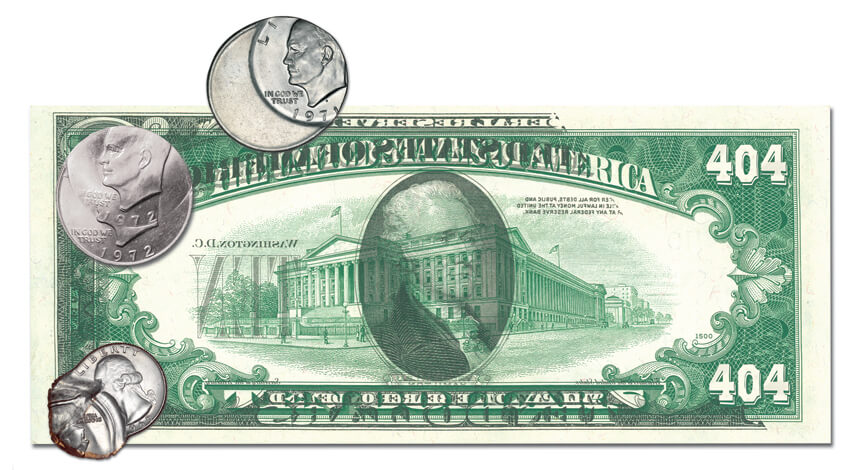
Although the U.S. Mint adheres to strict quality control standards, errors in coin production do occur. One coin or many every year may bear a particular mistake or any number of mistakes. Values are based on the rarity and severity of the error, as well as the denomination. Due to the subjective nature of error coins, no published price listings are available that consider all possible factors, denominations and dates.

Several publications detailing die varieties are available for purchase through the ANA MoneyMarket. Or you may want to contact a national collecting group whose members specialize in the collection of errors. Try: CONECA (Combined Organization of Numismatic Error Collectors of America)

When determining the validity of errors, one must consider that coins may have been altered after they left the Mint. Error coins should always be authenticated by an expert numismatist and determined to be genuine.

23. I recently found a coin that is silver in color, but it is a cent from 1983. How did this happen?

Chances are you have come across a one-cent coin on which the copper plating has been removed to expose the inner core of copper and zinc, a white-toned metal. Coins that have been physically altered outside the U.S. Mint technically do not hold a legal-tender value.

24. I recently received a dime in change. There is no design on either side, but the size and edge appear to be normal. Is this a slug?

Generally if the edge is reeded, but the face is blank, the item is a slug. However, if the edge is smooth then the item is most likely an unstruck planchet. A blank will not bear a raised rim. You should see an ANA-member coin dealer for an evaluation.

25. I found a quarter that is thinner than normal, and one side is copper. Is this a true error or a manipulation?

It sounds as if one side, or layer, of the clad material either became detached or was purposefully removed. In this case, it is best to obtain the advice of a local ANA-member dealer who can physically examine the coin to determine if the coin was altered after it left the mint. You will find dealers listed in the yellow pages of the telephone directory under "Coin Dealers." ANA member dealers promise to abide by our Code of Ethics.

26. I have a penny with a small portrait of JFK (John F. Kennedy) next to Abraham Lincoln. Was this a special issue?

The coin you describe is a well-known fantasy piece. This coin is not an error or an official issue, but was made by someone who manipulated a regular U.S. one-cent coin by simply stamping an image of John F. Kennedy next to Lincoln. Several variations on this theme circulate. None hold a numismatic value.

27. I have a gold coin from Blake and Co. It must be genuine since I found it in my grandmother's safe-deposit box.

The gold coin you describe is a replica that holds no numismatic or legal tender value. In 1969 Chrysler Corporation distributed the replicas as a premium to promote the 1970 "Gold Duster Valiant" model. The copies were struck in a base metal and covered with gilt to make it appear gold. There are thousands of these particular replica pieces in circulation.

In actuality, there are two known, genuine specimens of the Blake and Co. coin. One is held in the Lily Collection at the Smithsonian Institution and the other is held in a private collection.

28. I just purchased a colorized U.S. coin for my grandchildren. Can you give me any information?

The colorized U.S. "coins" advertised extensively are actually altered bullion rounds. Many companies with official-sounding names have purchased bullion rounds produced by the U.S. Mint, painted them with a colorful enamel coating and are selling the altered pieces to the public at premium prices. As a general rule, numismatic value is assigned only to unaltered coins--or coins as they are produced in the normal minting process.

The colorized rounds are more of a collectible and should not be considered a numismatic investment. The colorized coin may have a value to a collector interested in such an item. However, if you are interested in future numismatic value, you might wish to invest in coins offered directly from the U.S. Mint.

Spacer
Spacer
818 North Cascade Avenue Colorado Springs Colorado U.S.A 80903
Membership: 800-514-2646 General: 800-367-9723 Fax: 719-634-4085