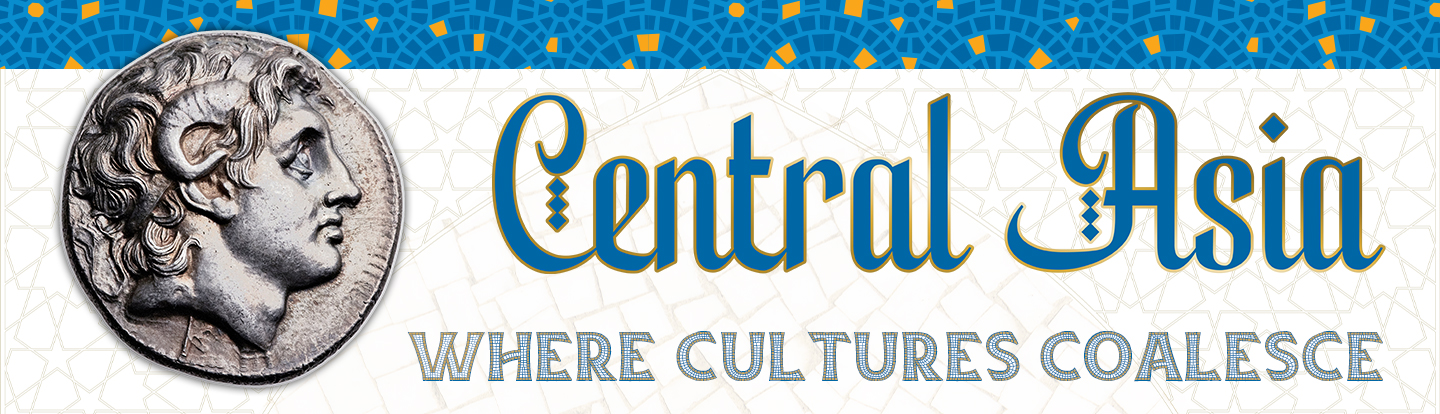
Alexander the Great created the first comprehensive imperial coinage struck with standardized designs and denominations throughout his empire. Alexander’s coinage became the model for all subsequent currencies in the regions controlled by him. Each developed variations of the originals after his death, including realistic portraits and legends proclaiming the names, accomplishments and attributes of their rulers.
Greek and Macedonian soldiers were settled in cities scattered throughout Central Asia. Following decades of civil war, the empire was divided into three major kingdoms – the Ptolemaic, Seleucid and Macedonian – each ruled by one of his successors. The largest, the Seleucid Empire, gradually fractured into splinter kingdoms during the third century BC. The easternmost and most powerful was Bactria.
Indo-Greeks
Located in what is now Afghanistan, Bactria became a powerful focus of Hellenism for over three centuries, which spread and melded with local cultures as the kingdom expanded. Conquering territory as far as northwest India, Bactria flourished under a series of powerful kings. However, the late second century brought nomadic invaders – including the Yuezhi and Scythians – who weakened and reduced the kingdom. Relegated to what is now Pakistan, Bactria split into several minor kingdoms, which maintained Indo-Greek Hellenistic customs long after their isolation from the rest of the Greek world following Parthia’s conquest of Mesopotamia.
Indo-Scythians
As early as the ninth century BC, sources tell us of the Scythians. Originally of Iranian stock, after adopting horse-riding and the composite bow, they formed the prototypical militarized steppe confederation. During the eighth and seventh centuries BC, Scythian tribes conquered sedentary, agricultural Greek city-states as they slowly migrated from Central Asia to southern Russia and Ukraine, establishing a powerful Hellenized empire in the Crimea. Moving eastward into Central Asia, the Parni tribe of the Dahae Scythians founded the Parthian Empire in 247 BC, while others continued into northwestern India. From the second century BC, Scythians, or Saka, as they were known in the east, founded numerous small kingdoms that endured for over 600 years. The resultant Indo-Scythian peoples gradually conquered the Indo-Greek kingdoms and others until their subjugation by the Kushans in the late first century AD.
Kushano-Sassanian
The Sassanians captured the Kushan’s Sogdian, Bactrian and Gandharan provinces in 225 AD, inheriting a robust Greco-Bactrian culture, which mixed with their own. The resultant Kushano-Sassanian influence appears on the coins minted by Sassanian governors – who adopted the title of Kushan shah.
All of these empires shared the legacy of the Hellenistic culture left by Alexander’s successors, blended with native Bactrian, Gandharan and Indian cultures and further modified by successive waves of steppe invaders.
Click on the items in the case image below for an enhanced view