When Diocletian ascended the throne in 284 AD, the Roman economy was on the verge of collapse. Civil wars, barbarian invasions and pandemics plagued the empire, which was further strained by the contraction of the Silk Road network and appearance of a new aggressive challenger to the East – the Sassanian Persians. Rome was in crisis. In response, Diocletian instituted five major reforms: 1) Currency 2) Fixed prices and wages across the empire 3) A census to determine administrative costs 4) Taxes, reducing corruption and increasing revenues and 5) Overhaul of the army, civil service and regional governments. The empire was divided into two administrative divisions between coequal Emperors, the Augusti, each with an assistant, the Caesars. The empire was renewed and its survival ensured until the next major crisis at the end of the fifth century.
The division of the empire soon broke down as, predictably, the Augusti fought each other for control. Constantine the Great (306 – 337 AD) battled Maxentius (307-312) for control of the empire. Legend has it that Constantine had a vision of Christ before the decisive battle of the Milvian Bridge against Maxentius. Constantine was commanded to carry a likeness of the Cross into battle and emblazon his soldiers’ shields with the Chi-Ro monogram (“XP”, the first letters of Christ in Greek). This he did, and when he defeated Maxentius in 313, he proclaimed Christianity as the new state religion, and commemorated it on his coinage. Constantine’s victory and subsequent conversion renewed the Empire, which would last another millennium. In 330, Constantine established a new Christian capital at Constantinople, where he was finally baptized.
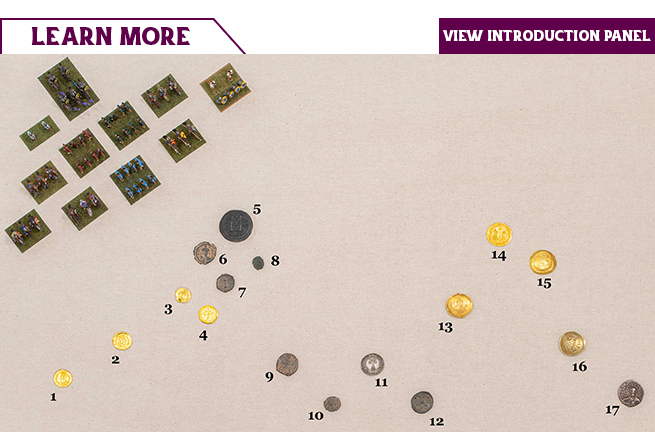
In the wake of Constantine’s victory, he purposefully broke tradition and replaced the representations of Mars and Apollo on coinage with Christian symbolism. On shields, helmets, standards and coins, Christian symbolism transformed the empire with religious iconography that we still use today.
Click on the items in the case image below for an enhanced view