Fueled by military success, a first-class transportation system and political cohesion, the Roman Empire amassed wealth and influence, which was divided amongst an upper class of unparalleled size. Their desire for exotic luxuries and collective buying power generated a robust demand for trade. As a result, luxury production across Eurasia soared, which spurred the development of sophisticated Silk Road trade networks.
Roman Imperial Coinage is a vast subject, recording social, political and economic changes within the empire. Beginning with Augustus’ initial monetary reforms in 27 BC, the new coins quickly spread throughout the empire with standardized denominations in all metals. This system lasted with minor changes until the third century AD. In 290, Emperor Diocletian instituted sweeping reforms of the Roman government to save the economy, which had begun to falter under pressure from civil wars, invasions and plagues. Roman society was fundamentally changed – including the coinage, army, civil service, regional government and coinage – to increase efficiency. Most notably, the gold solidus, which became a dominant currency in Eurasian trade for centuries, replaced the heavier Augustan gold aureus.
In 395, the Roman Empire permanently split into Eastern and Western halves, each ruled by its own emperors with increasingly independent politics, culture and economy. Both halves, threatened by invasion and economic collapse, debased their coinage – especially bronze and silver. The West, with fewer resources, slowly disintegrated over the 5th century, finally ending with the sack of Rome in 476 AD. The Eastern Empire, centered on Constantinople, managed to survive, recovering in the 6th century under strong Emperors and developing a new culture based on Christianity and the Greek language, which became known as the Byzantine Empire.
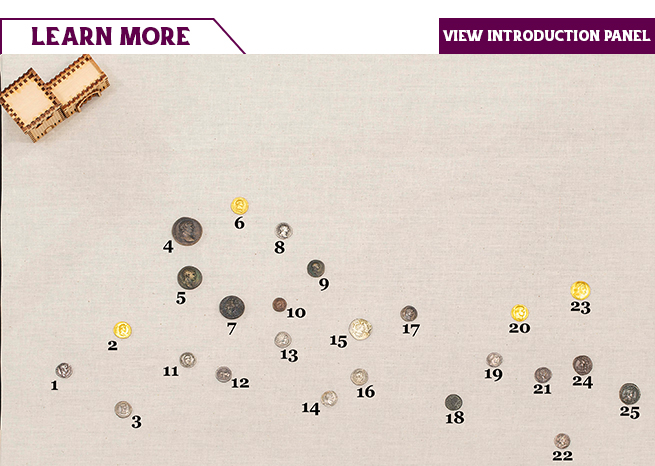
Click on the items in the case image below for an enhanced view