The Indus Valley culture (c. 2600–1900 BC) was one of the three Eurasian cradles of civilization along with Mesopotamia and China. Seated along the Indus River, local cultures developed from pastoralism to settled, urbanized agriculture. A wave of Indo-Aryan migrations (1800-1500 BC) brought new settlers and languages to India, laying the foundations for the Vedic period (c. 1500-500 BC), which resulted in the development of Hinduism, social stratification, and regional kingdoms as urbanized agriculture spread to the Ganges and other great river valleys.
Beginning in the 6th century BC, the Persians conquered parts of northwestern India and introduced the concept of coinage. Alexander the Great’s epic conquests between 327 and 325 BC claimed the whole of the Indus River valley from Taxila down to the Indian Ocean. In the following century, the Bactrian Greeks conquered much of northwest India – beyond Alexander’s conquests – bringing Greek-style coinage with noteworthy modifications, including bilingual inscriptions and square planchets.
In the second century BC, the nomadic Yuezhi confederation conquered Bactria. The Indo-Greeks within India formed several independent kingdoms before the dominant Yuezhi tribe formed the Kushan Empire (c. 30-375 AD). Combining native Bactrian, Greek and Indian cultures, it was a new and dynamic force that bridged East and West. While continuing the Kushan legacy of cultural tolerance, the Gupta Empire (320-550) adopted a Hindu-focused identity that spread across most of the Indian subcontinent. They encouraged scholarship and art, forming the basis of Indian culture ever since. In the sixth century, the Gupta Empire collapsed, breaking into smaller, regional kingdoms under pressure from a new group of Steppe invaders, the Huns.
The eighth century brought Umayyad Islamic invaders, who began to conquer northwestern India and introduced Islamic coinage to the sub-continent in Sindh province (Pakistan). Hindu kingdoms managed to delay further Islamic incursions into India until the 12th century. However, in 1175, Muhammad bin Sam Ghori, founder of the Ghorid dynasty, conquered northern India. He imposed strict Islamic law onto the region, which heavily influenced Indian money. Islamic coins re-introduced dating and mint marks, making Indian coinage an important source of the subcontinent’s political history for the first time in 800 years.
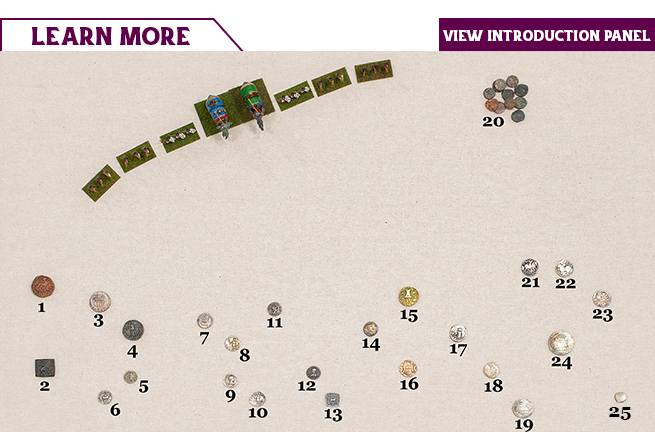
Click on the items in the case image below for an enhanced view