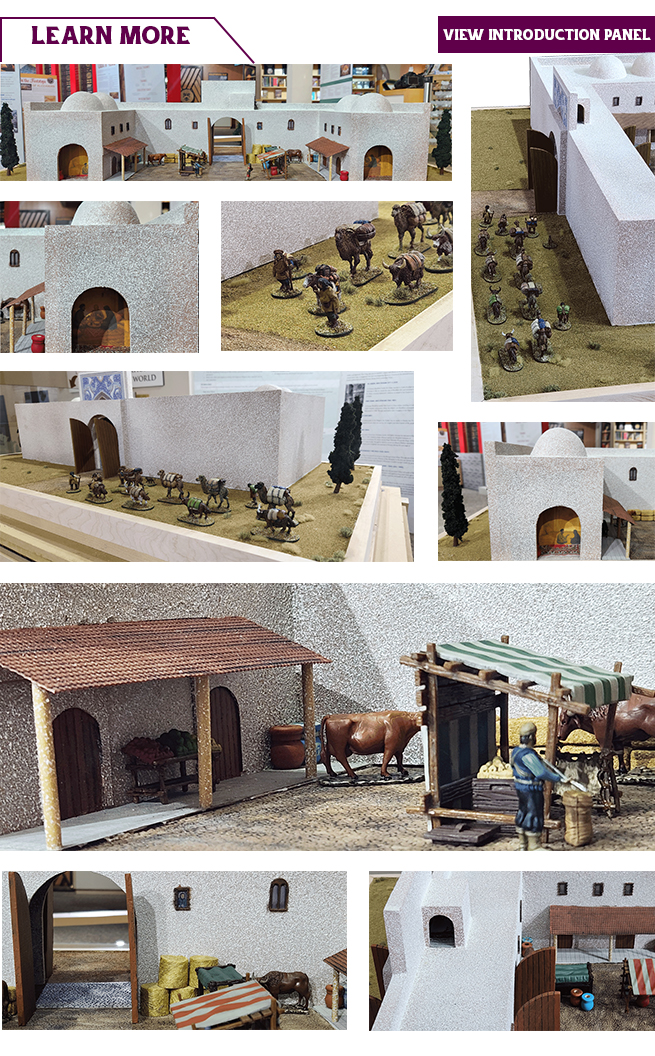
Alongside merchants and nomads, camels, horses, donkeys and yaks left their hoof prints along the Silk Road. Beasts of burden, they transported people and wares across the treacherous terrain, which was too sandy, rocky or barren for wheeled carts. Caravans of animals and traders traversed a network of routes, finding protection and shelter at caravanserais.
Caravanserais were fortified roadside inns spaced roughly a day’s journey apart along main arteries of the Silk Road network. Offering accommodation, food and security, they were bustling cultural and economic centers of exchange. Safe havens among the harsh, remote terrain, caravanserai made long distance trade viable. With the help of working animals, caravanserais fostered the movement of goods, ideas and coins across continents.
In Central Asia, the camel and horse facilitated international trade and diplomatic relations. First domesticated in North Africa and Southern Arabia circa 4000-2500 BC, camels spread east and west, reaching China by 100 BC. Single-humped dromedaries traversed western Asian routes, while double-humped Bactrian camels were better suited for colder climates in central Asia, Mongolia and eastern China.
Camels are uniquely adapted to survive in the harshest conditions. They can endure long distances without food or water and carry up to
500 pounds. On route, camels were important resources; they provided milk (and sometimes meat), while their wool was spun into ropes
or blankets. Their versatility and endurance made camels the ultimate transportation – symbols of commerce and status across the
Silk Road.
Another symbol of wealth and prestige, the horse was domesticated between 4000 and 3000 BC. Though originally raised for milk and meat, their utility for transport and chariots transformed warfare across Mesopotamia and Egypt by 2000 BC. By 1000 BC, breeding programs had developed horses large enough to be ridden into battle.
In China, they relied on sturdy steppe horses, adapted over centuries to the harsh conditions of Central Asian steppes until they discovered “Celestial” Ferghana Valley horses (c. 138 BC). Larger and more visually impressive, they were desired by the Chinese elite. Imported as status symbols at great expense, the Ferghana horse initiated centuries of exchange between China and the West. Yet, more than 1000 years later, the fearsome Mongol tribes still relied on the dauntless steppe horse, which ultimately built the largest land empire ever known
Click on the items in the case image below for an enhanced view