As the Silk Roads trade network developed, land routes and maritime routes combined and extended, adding new goods, cities and markets to merchant itineraries. Previously uninvolved states and empires benefited from and added to the rich milieu of goods, cultures and ideas that traveled with ships and sailors.
Many of the port cities along the maritime network were already ancient by the first century BC. However, their established networks were limited to regional, mostly coastal, shipping. As technology improved and knowledge grew about both the destinations and monsoon patterns, adventurous merchants began to travel further afield in search of profits. One of the few surviving primary sources for these routes is the Periplus Maris Erythraei (40-70 AD), a guidebook of maritime trade routes by an unknown Greco-Roman author. It lists the ports and coastal landmarks from west to east, documenting approximate distances between them as well as trade and political opportunities.
The Silk Road land network initially connected to the ports of southern and western Asia, shipping silk and other exotic goods along the burgeoning network. Expanding quickly, maritime routes from western and southern India bustled with trade to the Persian Gulf, Red Sea and east Africa. Indian ports, including Barbaricum and Barygaza, were transfer points where the eastern end of the western maritime trade met the land routes from China. Muziris, in the far south of India, connected the South East Asian maritime routes to the system. In the Persian Gulf and Red Sea, the ports of Charax Spasinou (Iraq), Eudaemon Arabia (modern Aden, Yemen) and Arsinoe (Egypt) shipped and received items between East and West. At the far end of the network were the port cities of Sarapion and Nicon (Kenya). Greeks, Romans, Arabs, Persians and the diverse peoples of India all participated as sailors, captains and merchants.
Silk Road harbors were melting pots where languages, religions and currencies overlapped far from their original homelands. Port cities often operated as independent or semi-autonomous powers, enriched by customs duties and on foreign trade. Not just stopping points, Silk Road “ports of call” were destinations in their own right, shaping the course of Eurasian history as thoroughfares between continents. e echoes of their influence are still found today in coastal cities and modern air and land transportation hubs, where languages, religions and currencies continue to mix in new ways to shape and influence our world.
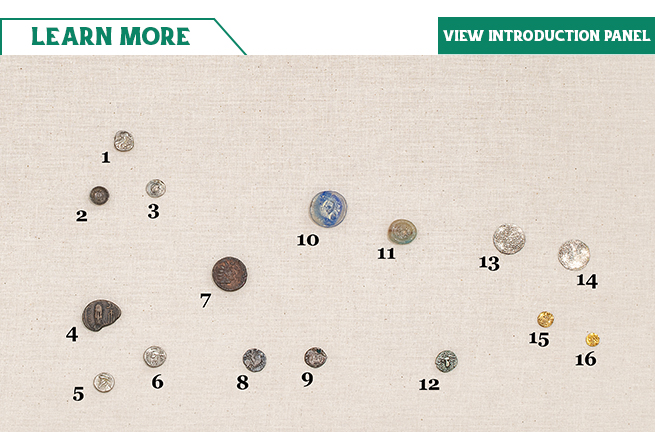
Click on the items in the case image below for an enhanced view