Money Museum Showcase Highlights
Show attendees have the opportunity to see some of the world’s most beautiful and valuable coins, paper money and related numismatic treasures not seen anywhere else.
The Museum Showcase features rare and historic items from the ANA’s Edward C. Rochette Money Museum and items generously lent to the ANA from private collections.
Select images to enlarge.
The 1804 silver dollar is among the most coveted of all U.S. rare coins, with only 15 known examples. Strangely, no dollars dated 1804 were actually struck in that year. The United States Mint struck only dollars dated 1803 in 1804, and then ceased regular production of silver dollars until 1840.

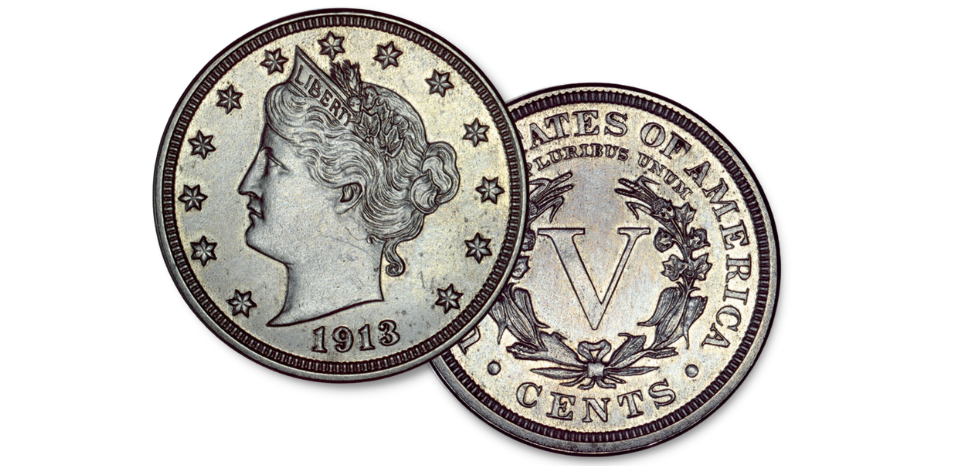
The story of the 1913 Liberty Head nickel begins with a mystery — no one is sure how or why the five known pieces were produced. Over the years, the “fab five” have become some of the world’s most valuable coins and have consistently been among the price leaders in the numismatic market.
Washington’s military skill and bravery is celebrated on a wide range of medals, most notably the Washington Before Boston medal, the first medal commissioned by the Continental Congress, first Congressional Gold Medal, and first medal commissioned in the Comitia Americana series celebrating Revolutionary War heroes. In 1782, Washington established the Badge of Military Merit; its successor, the Purple Heart, features his likeness. This exhibit illustrates Washington’s reputation as a military leader as seen through the many medals issued in his honor.

Promises in Silver: The Changing Face of Indian Peace Medals in the United States
(The joint American Numismatic Association and American Numismatic Society Indian Peace Medal exhibit.) Indian Peace Medals were crucial diplomatic tools used from the late 17th century until the end of the 19th century to establish and maintain alliances with Native American leaders. In 1793, Thomas Jefferson described the practice as an “ancient custom” and defined the medals as marks of friendship, goodwill, and diplomacy that conferred no actual power but served as vital gestures of peace.

Athena’s Owls – Icons of Silver – Courtesy of the Arcadia Collection
The Athenian “owl” silver tetradrachm is famous as one of the most influential coins of all time. During the fifth century B.C., when Athens emerged as the greatest of all Greek cities, owls were the most widely used international trade coin and helped spread Greek culture throughout the Mediterranean world. The heyday of Athens, between 510 and 406 B.C., witnessed the birth of democracy, the construction of the Parthenon, the pinnacle of classical art, the evolution of philosophy, and the origins of Western literature.

A Liberty for All
In 1792, the United States struck a quiet revolution in metal. For millennia, coins carried the faces of power. From ancient rulers to European monarchs, a portrait on money identified the authority behind the coin, while turning each transaction into daily propaganda of who governed and how all-powerful they were. However, George Washington firmly believed the American Republic should be different as its people were sovereign. This exhibit highlights the adoption of Liberty to grace our nation’s first coinage and how her image has changed over the last 250 years.

Satrapal Coinage of the Achaemenid Persian Empire
This display features beautiful and rare Greek-inspired coins issued while the region was under Persian domination. Among the treasures are the earliest coins depicting actual portraits of people (the Persian Satraps) rather than gods or allegorical figures. The coins illustrate a time over 2,300 years ago, when east (represented by Achaemenid Persia) and west (represented by the Greek City-states) were at odds, facing off in the Middle East with competing cultures and political systems. This display is made possible by a generous loan from John Nebel.

The Forgotten Emergency Money of WWII
This exhibit features an impressive collection of Emergency World War II notes issued by the U.S. government to prevent enemy forces from using captured American currency if the Hawaiian Islands were invaded. These notes could be immediately identified by the large “HAWAII” overprint on the back and demonetized should the islands be captured. Hawaiian emergency notes were issued between 1942 through 1944 and are represented by a very special series of rare “star” replacement notes.

The Spectacular 1921 $20 Double Eagle PCGS Satin Proof 64+
At the beginning of the 20th century, President Theodore Roosevelt’s dream was to reinvent American coinage to reflect the greatness of the world’s most powerful democracy. he worked closely with the premiere American sculptor and medalist off the time, Augustus Saint-Gaudens, in order to realize his vision. The result was a masterpiece: the Saint-Gaudens $20 Double Eagle (1907-1933). This display features one of two known examples of the extraordinary 1921 Satin Finish proof, on display courtesy of Brian Hendelson.

Two Versions of the Declaration of Independence
To celebrate the nation’s 250th, two items related to the original Declaration of Independence will be on display, courtesy of Brian Hendelson.
An 1848 Peter Force engraved copy of the Declaration of Independence will be featured. This printing of the Declaration of Independence appeared as an insert in American Archives: A Documentary History of the United States of America, Series V, Volume 1, compiled by Peter Force. Crafted by printer William J. Stone in 1823, the copperplate used to produce the present copy was originally commissioned by Secretary of State John Quincy Adams in 1820.
An equally rare engraved 1820 copy of Thomas Jefferson’s original rough draft of the Declaration of Independence will also make an appearance. This steel engraved facsimile of Jefferson’s draft of the Declaration of Independence was commissioned for the first published edition of Jefferson’s writings, edited by his grandson, Thomas Jefferson Randolph (1792-1875), under the title: Memoir, Correspondence and Miscellanies from the Papers of Thomas Jefferson. Jefferson’s “original rough draft” is the earliest surviving complete draft of the Declaration of Independence.


The Colonial Coin Collectors Club (C4) Presents: The America 250 Display
Long before the United States Mint opened in 1792, a remarkable variety of coins, tokens, medals, and paper currency circulated throughout the American colonies and the young republic. Colonial coins are more than collectibles—they are surviving witnesses to the founding of America. They passed through the hands of merchants, soldiers, statesmen, and ordinary citizens who lived through the events that shaped a nation. Each piece offers a unique glimpse into the commerce, politics, and daily life of early America.
Founded in 1993, the Colonial Coin Collectors Club (C4) is dedicated to preserving, studying, and sharing this extraordinary numismatic heritage and is proud to bring the story of these coins and medals to life through four exhibit cases:
1. Prelude to Revolution
The period from the French and Indian War (1754-1763) through the eve of the American Revolution were a period of warfare and triumph followed by disillusion as the colonists increasingly found themselves at odds with imperial policies. The medals, coins, tokens, and notes of the period reveal how the financial consequences of war transformed loyal British subjects into Americans increasingly determined to govern themselves.

2. Declaring Our Independence
The growing dispute between Great Britain and its American colonies culminated in the American Revolution. Hostilities began at Lexington and Concord in 1775, leading to the adoption of the Declaration of Independence on July 4, 1776. This case tells the story of the nation’s first medals and currency and how they reflect the events of the time and the evolution of the new nation. Together, these notes and medals document both the sacrifices of the Revolutionary era and the emergence of the United States as an independent nation.

3. The New Confederation
The American victory at Yorktown in 1781 and the Treaty of Paris in 1783 secured the independence of the United States. Medals commemorating these events were produced in Germany, France, and the Netherlands, reflecting widespread European interest in the success of the new republic and the diplomatic relationships it established abroad. The coins, medals, and paper currency of this period illustrate both the resourcefulness and the economic challenges of a young nation operating without a strong central government.

4. The Constitution and the New Federal Government
After the Revolution, the weakness of the Articles of Confederation led to the Constitutional Convention of 1787 and a stronger federal government with authority over the nation’s money. Monetary experiments and innovation combined with public admiration for Washington to highlight continuing efforts to establish a stable national coinage. The Coinage Act of 1792 created the first federal coinage, adopting Liberty rather than a living ruler as the principal design motif. The medals, patterns, tokens, and coins of this period trace the transformation of the United States from a loose confederation of states into a unified constitutional republic.
View the ANA Money Museum online!
Access virtual exhibits that allow you to view high resolution images and detailed information about fascinating numismatic collections.